“Jesus said to the chief priests and elders of the people: ‘Hear another parable. There was a landowner who planted a vineyard, put a hedge around it, dug a wine press in it, and built a tower. Then he leased it to tenants and went on a journey. When vintage time drew near, he sent his servants to the tenants to obtain his produce. But the tenants seized the servants and one they beat, another they killed, and a third they stoned. Again he sent other servants, more numerous than the first ones, but they treated them in the same way. Finally, he sent his son to them, thinking, ‘They will respect my son.’ But when the tenants saw the son, they said to one another, ‘This is the heir. Come, let us kill him and acquire his inheritance.’ They seized him, threw him out of the vineyard, and killed him. What will the owner of the vineyard do to those tenants when he comes?’ They answered him, ‘He will put those wretched men to a wretched death and lease his vineyard to other tenants who will give him produce at the proper times.’ Jesus said to them, ‘Did you never read in the Scriptures: The stone that the builders rejected has become the cornerstone; by the Lord has this been done, and it is wonderful in our eyes? Therefore, I say to you, the kingdom of God will be taken away from you and given to a people that will produce fruit.’”—Matthew 21: 33-43
_____
This was the Gospel read last Sunday, Twenty-seventh week in Ordinary Time. One thing I love about the Catholic Church is that we have the same readings—everywhere in the world, for every Mass—that follow a cycle so that passages and messages are not selectively chosen to fit the bend, ideations, or fixations of a single priest who—posing as instrument of God—uses passages selectively to serve one’s own personal purpose.
Still, in the cycle of our Church’s readings—and the living/playing-out of our present-day—I am often amazed at the timeliness and meaningfulness of the Church’s cycle with the happenings of our present moment. Perhaps such is sign and proof of Solomon’s spoken truth: “Vanity of vanities…there is nothing new under the sun.”
As I listened to this passage last Sunday, as good as our Father’s homily was, I couldn’t help, too, but to think on present happenings in our world.
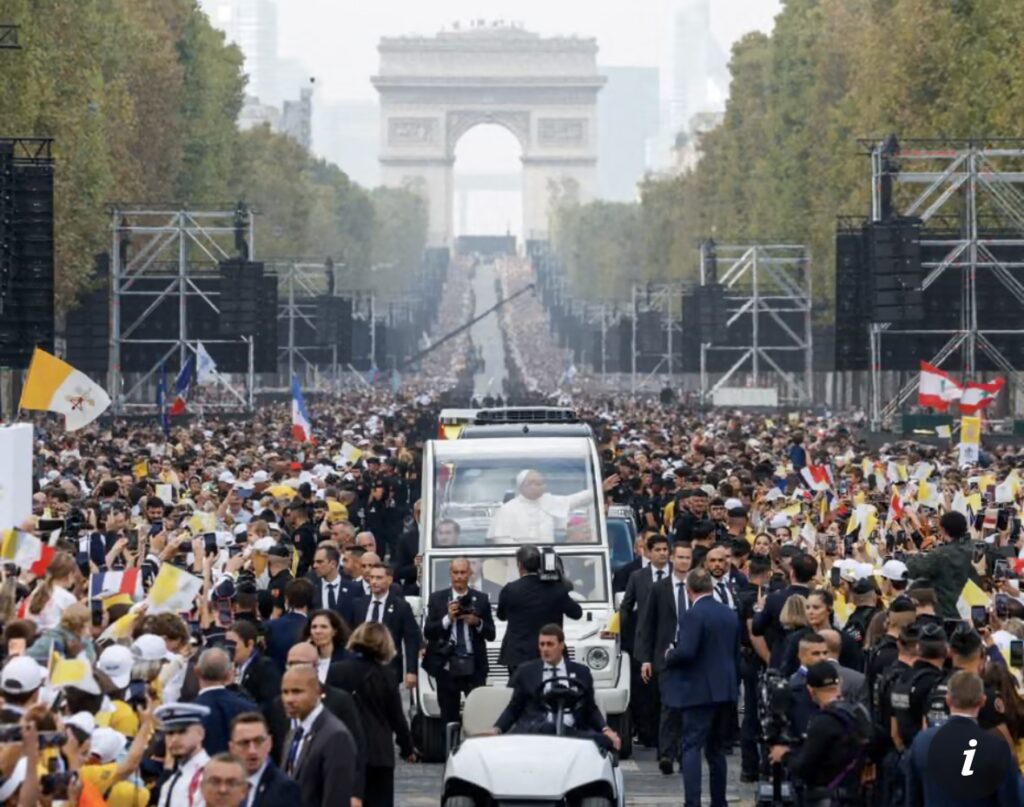
A week before, the Pope visited France—the Eldest Daughter of the Church. 800,000 people gathered in single group to see, welcome, and listen to his Mass in the open streets of Paris. No violence, no desecration, joy and symbols of country and faith. Priests sat on open streets—absent coercion, absent pressure and exploitation out of fear; simply inviting and being present, should someone desire—to receive confessions and return, as instrument, God’s and grace and reconciliation to any person who aimed to lighten their soul from what made them heavy and reconcile, with God and self, what made them divided and distant.
It was a beautiful reality of the Goodness present and alive in a people and country.
One week’s time, and still, scenes of the nation’s streets are entirely changed: fires, riots, destruction of schools, looting of stores; attacking of police, teachers, principals, and simple bystanders who for asking questions are lit on fire.
Make it make sense…
We live in a spiritual world. God, and his enemies remain as they have for all of human-time: in competition for souls, minds, and influence on this earth.
We saw the Good that came and expressed itself in the celebration of Church that set cornerstone and precedent for much of a people’s culture and history.
After, we see what comes in counter-response of those who share neither culture nor the Church.
The aggressors and destroyers on European streets, few are of Christian origin. Much are of a culture that, for 1400 years, has set design to rid all religions other than itself from the face of this world.
Dynamics of the people, who define this nation and culture have changed. There is rebellion in the vineyard—active violence and usurpation. Some tenants believe that they have won, or will win, because the patience, grace, and repeated offering of God, Christ, and the cultures founded upon to reconcile and make peace is mistaken for weakness when in fact it is practice of Christ’s new commandments and examples: “to love they neighbor as they self, to love one another as I have loved you, to forgive and you will be forgiven…” again and again, “…seventy times seven.”
There is a lesson for the tenants: it is not their vineyard, and in their avarice, violence, and desire to take what does not belong to them their own, end state will play as parable tells.
There is a lesson for the vineyard-owner: “Did you never read in the Scriptures: The stone that the builders rejected has become the cornerstone; by the Lord has this been done, and it is wonderful in our eyes? Therefore, I say to you, the kingdom of God will be taken away from you and given to a people that will produce fruit.”
Absent the cornerstone, all built upon will fall. Even when a culture believes it has built above and beyond what beginning and foundation could ever imagine, absent the cornerstone, nothing above can stand.
Time and again, Old Testament prophets and history show this true. “Vanity of vanities…there is nothing new under the sun.”
Two week’s time, we saw the contrast of extremes. Which world and culture do we desire? Which will a people choose?