“…I had yet to see myself become part of a story. I had as yet no notion that life every now and then becomes literature—not for long, of course, but long enough to be what we best remember, and often enough so that what we eventually come to mean by life are those moments when life, instead of going sideways, backwards, forward, or nowhere at all, lines out straight, tense and inevitable, with a complication, climax, and, given some luck, a purgation, as if life had been made and not happened.”—Norman Maclean, “USFS 1919: The Ranger, The Cook, and a Hole in the Sky”
_____
Last page read, the story ended, and she felt a sadness and inner cool begin to take at closing of the page. Even in closeness to the hearth, its light and heat of fire strong, the coldness took within at the ending and wonder of “what next?”
It was the last story she had brought. She did not want for the stories to end, to return to small talk, empty askings and answers that shared nothing of the spirit.
She wanted the stories—life as literature—and without the words gathered, refined, becoming art in time, it seemed some of life’s romance died.
She did not want the stories to end, to return to a common world of common conditionings and empty habits. She wanted spirit and visions and sensings in soul of kind great stories told.
Near in room, upon open table, eyes lit on a book with hand-drawn fly and cover of tawny hue, like streaks of straw after summer wheat harvest—the lighter passes where straw is laid forward in direction of travel for full lighting, without shadow, of high bright sun.
The book was not hers. It was his, but untaken or claimed, and in the small body of the fly and tone of the cover, she felt something of a draw—a kind one feels but can’t explain and draws one into further desiring to learn.
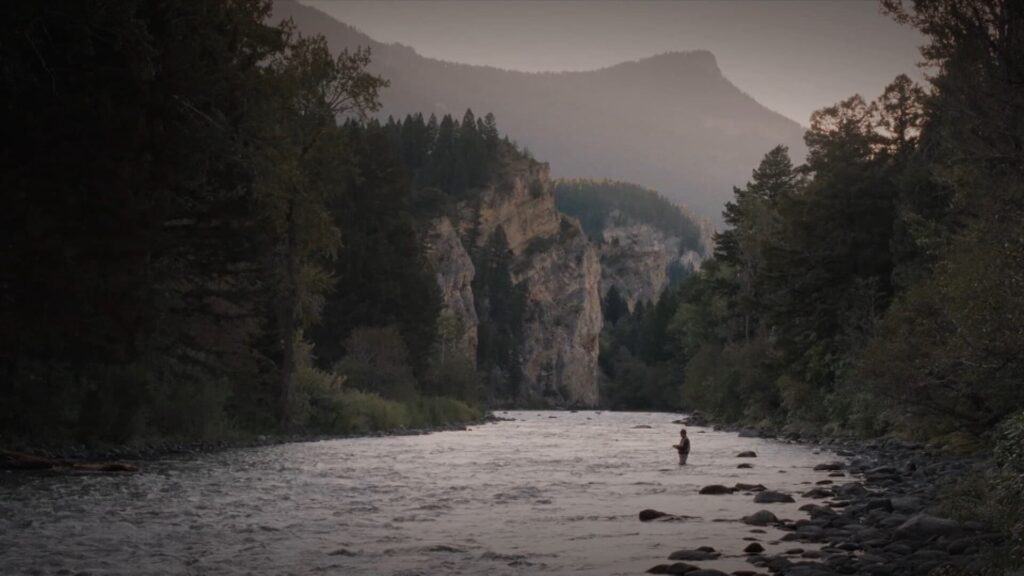
It was a western story, of mountains and trees, rivers and fish—and lives defined in their valleys and shadows in present and after-memories.
She began into the tale:
“In our family, there was no clear line between religion and fly fishing. We lived at the junction of great trout rivers in western Montana, and our father was a Presbyterian minister and a fly fisherman who tied his won flies and taught others. He told us about Christ’s disciples being fisherman, and we were left to assume, as my brother and I did, that all first-class fishermen on the Sea of Galilee were fly fisherman and that John, the favorite, was a dry-fly fisherman.”
In the cabin in woods, by fire’s hearth that smelled of ash and cherry, not far-mountain fir and pine, story drew her in. Page upon page, she read a spirit; life as literature in word-memory of a dreamer and artist.
She had stories too. One day she would catch their spirit, define life and soul in art that touched others into recognitions and resonance with their own.
“One of life’s quiet excitements is to stand somewhat apart from yourself and watch yourself softly becoming the author of something beautiful.”
Hush of wind whispered low in press to cabin walls. In the hearth, fire wavered in effect of the winds that bent invisible’s tie of sky to flame through energy of chimneyed column-rise.
She stared at the light, listened to world, struck in the tell of the words.
She felt it then, the beginning detachment and distance and sense of self in new perceive of way: becoming of an author, to something beautiful—life and story becoming as literature, telling and expression of a beauty willed, desired, and dreamed; or simply found in new paradigm-discernment.
She lost herself within the story; disappearing and drawn into mountains and history, alive in the capture and conspire of words that restored one soul’s past again to life.
She wanted a life as that, the beauty and spirit; life as literature saved and recorded, first in mind and in then in word, refined and improved in the savings and discardings of life made to memory in time and experiences between.
For hours she sat, held in the story, unmoving from rest and place. She lost herself in spirit and time—gone from the body, present in mind—as she lived story in herself.
In dark of night past winter’s longest, each dawn creeping nearer to come and return of spring, she lived in the romance of a fisherman’s mind, the way he wrote and told the river.
“…It was here, while waiting for my brother, that I started this story, although of course, at the time I did not know that stories of life are often more like rivers than books. But I knew a story had begun, perhaps long ago near the sound of water. And I sensed that ahead I would meet something that would never erode so there would be a sharp turn, deep circles, a deposit, and a quietness.
The fisherman even has a phrase to describe what he does when he studies the patterns of a river. He says he is ‘reading the water,’ and perhaps to tell his stories he has to do much the same thing. Then one of his biggest problems is to guess where and at what time of day life lies ready to be taken as a joke. And to guess whether it is going to be a little or a big joke.
For all of us, though, it is much easier to read the waters of tragedy.
‘Did you do any good?’ The voice and the question suggested that if I woke up and looked around I would see my brother. The suggestion became a certainty when the voice asked, ‘What the hell are you doing here?’
‘Oh, just thinking,’ I answered, as we all answer when we don’t know what we have been doing…”
Right then, she heard his voice, broken from mind-state of dream. She’d held longer to the page, ceasing to read as she mused on the passage and meaning. In break of pattern and timing of pages’ turn, she’d broke him from his own reading and mind-state. Attention drawn to her, he watched her in the fire’s cast, warm illume and bathe of her figure in yellow and golden light, soft dance of flickers in lapping of wood, stronger dance when night-wind blew in bellow-whisper upon wall and draw to high columned flame-connection.
“What are you doing?” he asked, reading her mind afar.
Her body shifted soft in rest, movement of spirit’s return from afar and restore again into. Face blushed in a meek expression, change lovely in fire’s matched spirit-illume—warm brighten of the rose.
“Oh, just thinking…” she answered uncertain what it was exactly she had done but believing that the moment, thought, and musing had meant something.
One day, she’d find the words.
A story began. This, she felt. This, she knew though she had not yet the words to say: her life, right then, a literature.