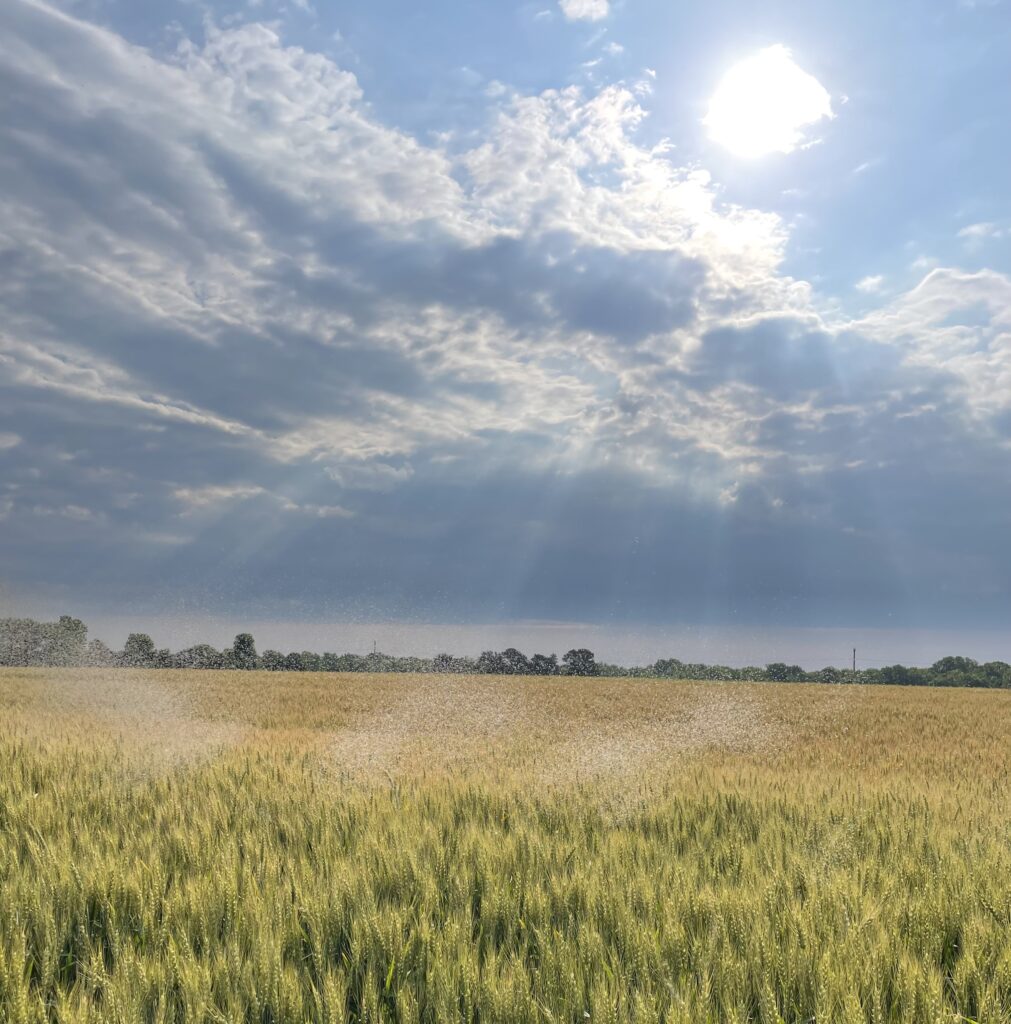
White dust rose in wake from limestone road as he drove the two-lane road bisecting fields and tracts of land in neat square-mile grid. Crops told themselves by change in colors, row spacing, heights, and leaves.
Corn shone in thirty inch rows, leaves dark green in upward column rise, levels of leaves opening broad to cover space between as leaves and plant grew in stacking climb to sky. In the heat and aridity of the season, leaves contracted, curling in upon themselves to guard against a sun that drew water, scarce, away from living plant; then, when cloud or sky would cool, leaves opened again—contracted sign of stress released as column rose in softening of sun’s flame.
Beans appeared in narrower rows, fifteen inches. Split of cotyledons, two halves of risen seed lined as deep green stripes across the dry earth; paler green beginning where the first true leaves of begun to grow. Where the corn stressed, the bean thrived, at least in such early stage; but without rain, soon all that grew would suffer.
He did not think of these. It would rain or it wouldn’t. Such was beyond his control and so, in equanimity, he left his worry to the same.
Unlike corn and beans—absent rains to fill the heads with spores to steal from yield and quality—the wheat was made. Day by day, it changed before viewing and passing eyes. Gone was the deep leaf green of March and April, the brush-stroke yellow-green of awned emerging heads of early May.
Now, it was only waiting: waiting for the plant to die, the grain to dry, for the weighted heads to turn and curl downward in their burden—sign for harvest’s start.
Beside the roads, above depressions in ditches that hold water after rains, midges hatched and held as pale clouds that, under sun and sky, appeared as living fronds and ends of fanned light-rays cast from focused sun in height transcending rainless cloud beneath.
He watched the cloud-dance of hatch, ephemeral moment that is epitome and purpose of another existence—to keep alive the cloud and dance by concupiscence and possibility for one more season’s hatch; year by year, eternal, until destruction of the world or ceasing of attraction.
He watched the life-cloud dance in the cast of light from sun and thought back into a youth-spring that, like that of living world, was forever past in slide of time and sky into summer’s change; ever so subtle and only discerned when sun is not the same and serenity and gentleness of season’s hope and signs are changed.
*****
There are seasons and experiences in life that, like photograph left to time and light, pale and fade in time; and there are others, no matter exposure or time between, keep vivid in memory and mind; never dulling in all the times life page is opened, returned to, and touched once again.
So was she as memory and page in summer of life-spring.
The details that held, always, was the innocence. Innocence of tan lines, of shorts and shirt that covered, checkered-pattern of sandals over feet when removed on the soft forest floor: signs and showings on skin of a spirit that did not care to show itself to world but wanted known and seen by him.
To him, she was always innocent; but there is a time and age when even innocence, no longer wills to wait. When such came, it shone in her eyes, no longer daylight-rapture, but a flame that in flicker, cast shadow of mystery; and when her season came, honest too of his desires, he loved her as best he knew.
Each shy and cautious, few with words but rich in sense and sign. In signs, they danced like life clouds that held above the fields, circling, drawing near, distancing in soul-wrote dance; flirting, drawn, and scattering back in purpose of attraction.
Then, dance changed. Purpose was known, awkwardness and uncertainty, searching in other for assurance through and after; a beginning to learning mystery all must learn in time if man is to exist beyond every present age.
Still, there was always the innocence: dressing again, tan lines and open skin covered again, white t-shirt’s lavender glow under silver moon; but not the sheen as like-toned skin.
And, in the after, dance continued: flirt and fleet and draw in times they each were near; parties and bonfires—flickers of stares and catching eyes, fleet but telling, through same of campfire lights; when each would disappear and, lost, find themselves together.
Whether noticed or not, they didn’t care; and, in again, they loved and learned more strong and truer than in before; understanding, more open, to each other and themselves—giving, taking, sharing, making together what dance and draw brought to be.
They made love in the woods, on days when humid, still air held heavy and canopy of trees was further layer to the burden; and then, with gentlest breeze, breath of wind, it all would change; a coolness, a sweetness, a comfort in stirring through the shade.
They entered into woods as skyline lit in flame of sunset fire, beginning in woods and moving to open meadow when it was only moon and stars above; making love in ideal of endless summer night that ended when dream-rose light of dawn woke behind silhouette of trees.
He remembered in the fall, the false-hope of Indian Summer when wave heat returns and one believes—or lies to one’s self—that such may be forever, so long as one denies signs and change in leaves and grasses that surround.
Together, they lain beneath the great white oak whose branches spread low and wide in shelter and shade that oversaw span of prairie never broken from its sod. They made stronger, held tighter, each in fear to lose their season already ended by world’s change.
When daylight rose, they stared on the open prairie, the sea of bluestem grasses—a blue-green span of prairie sea in summer—telling then as paled leaves and stems of deep maroon as the understory leaves of the great white oak tanned; tree’s life drawing in upon itself in preparation for a winter, saving its life and colors and hope for a future-coming spring when it would reveal and share itself again.
Then, as leaves in fall, they fell and drew apart, scattered in a wind; summer’s seeds, like acorns of the oak, falling and covering—waiting—until future spring when each grew into beginning of their own life and family trees.
*****
He watched the living clouds in dance as living ends of sun-ray light and remembered the way they shone and lived the same the first time they drove and lain beneath the trees.
It was always an innocence.